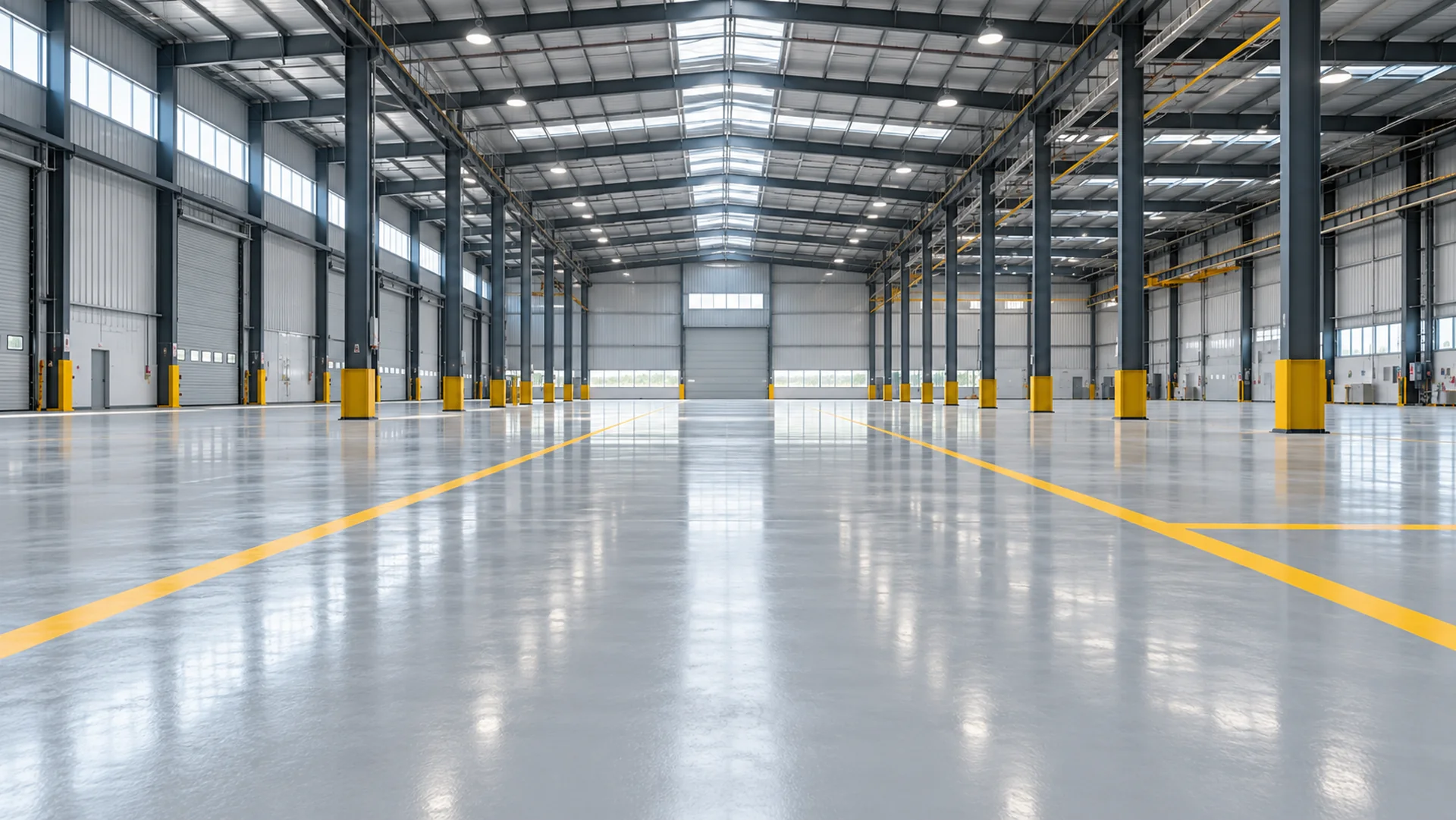
Industrial Floors Built for Daily Use
Industrial flooring has to withstand far more than normal pedestrian traffic.
Depending on the environment, the floor may be exposed to:
- forklifts
- pallet trucks
- machinery
- oils
- cleaning chemicals
- dropped tools
- production traffic
- heavy pedestrian use
A successful floor painting project therefore starts with understanding how the floor will actually be used.
The coating system can then be matched to both the substrate and the operating conditions.
Industrial Floor Preparation
Preparation is one of the most important stages of industrial floor painting.
Existing concrete may contain:
- laitance
- surface contamination
- failed previous coatings
- worn patches
- cracks
- damaged joints
- oil contamination
- polished power-floated surfaces
Where necessary, the floor is mechanically prepared before painting.
Typical methods include diamond grinding and mechanical coating removal.
Floor PreparationPainting Existing Industrial Floors
Many industrial floors do not need complete replacement.
Where the substrate remains structurally suitable, an existing floor can often be prepared, repaired and recoated.
The process can include:
- inspection
- testing of existing coatings
- mechanical preparation
- local coating removal
- concrete repair
- primer where required
- application of the selected coating system
- line marking
This approach can provide a significant visual and functional improvement without replacing the underlying slab.
Epoxy Industrial Floor Painting
High-build epoxy floor coatings are widely used for industrial refurbishment because they can provide a durable, seamless and easily cleaned finish.
Depending on the specification, epoxy coatings can be used in:
- warehouses
- factories
- engineering areas
- workshops
- plant rooms
- logistics facilities
- back-of-house commercial areas
Smooth and Anti-Slip Finishes
Different areas within the same facility may require different textures.
A smooth coating may be appropriate in dry areas where easy cleaning is important.
Textured or anti-slip finishes may be more suitable in:
- wet areas
- ramps
- entrances
- loading areas
- process zones
- pedestrian routes
Floor Painting Around Operational Facilities
Complete closure is not always practical.
Where site conditions allow, work can sometimes be phased around:
- production schedules
- racking layouts
- loading areas
- forklift routes
- weekend shutdowns
- planned maintenance periods
The programme needs to account for both application time and curing before the floor is returned to service.
Industrial Floor Painting Colours
Industrial floor colours can be used for more than appearance.
They can help distinguish:
- production areas
- pedestrian routes
- hazard zones
- traffic lanes
- storage bays
- machinery areas
- restricted areas
Neutral greys remain popular for large floor areas, with contrasting colours used for demarcation.
Industrial Floor Painting Process
Survey
Assessment of the existing floor and operating environment.
Preparation
Mechanical preparation suitable for the substrate.
Repairs
Cracks, holes and damaged areas repaired where required.
Primer
Applied where required by the system.
Coating
One or more coats of industrial floor coating.
Marking
Optional walkways, bays and safety markings.
Handover
Floor returned to service after appropriate curing.
How Long Does Industrial Floor Paint Last?
Service life varies considerably.
Factors include:
- quality of preparation
- coating thickness
- traffic type
- forklift wheel condition
- chemical exposure
- cleaning regime
- substrate movement
- maintenance
A properly prepared and specified industrial coating should always outperform a decorative coating applied directly over an unsuitable substrate.
Industrial Floor Painting Cost
The largest cost variables tend to be:
- size of area
- existing floor condition
- amount of coating removal
- repair requirement
- number of coats
- coating type
- slip resistance
- working hours
- programme constraints
Practical answers
Frequently Asked Questions
Can industrial floor paint be applied over old paint?
Sometimes.
The existing coating needs to be well bonded and compatible with the proposed system. Weak or poorly adhered coatings should normally be removed.
Can you paint power-floated concrete?
Yes, but mechanical preparation is typically needed to open the surface before coating.
Can damaged concrete be repaired first?
Yes.
Local repairs can be completed before the coating system is installed.
Do you paint very large areas?
Yes. Large warehouses and industrial facilities are a core part of the service.